SAC 2016 Songwriting Challenge Week 1

The Songwriters Association of Canada (SAC) runs an annual songwriting challenge for its members.  I did it last year and found the experience difficult but very rewarding.  One of my posts from 2015 is here.

The challenge this year is to write four songs in four weeks under the direction of a set of mentor/challengers.  Each week presents a different type of challenge.

SAC members who participate in the challenge are asked to record their result each week and post it online with some commentary.

So here we go …


The Challenge

The challenger is Toronto-based producer and songwriter Murray Daigle, who posted this for us:

Write a song using no more than 2 chords — OR —  Write a song that has a single repeating riff (1-bar in length)

This challenge is designed to make writers focus on fundamental “hooks” to create a great song. Also to underline the “catchiness” of the melody, vocal rhythm and lyric will be very important. This limitation takes away the writer’s ability to simply use a chord pattern change and define the musical space. You will actually have to write verses, choruses and bridges that define themselves and “speak” as they should in the context of the song.

Murray also provided a list of examples for us to consider, including some classics such as “Eleanor Rigby” (Beatles), “Born in the USA” (Springsteen), “When Love Comes to Town” (U2).


The Process

I went with the 2-chord challenge, although I had considered using my looper to try out something with a repeating riff.

Keeping to 2-chords is hard because there is such a strong desire to add a third chord for resolution and/or harmonic progression against the melody.  However, the challenge really forced me to pay close attention to melodic and rhythmic elements of the composition.

I listened to some of the examples provided by Murray and adapted a technique from “Eleanor Rigby” that I used to give a sense of movement in the song.  Here you can see how the Beatles simply reverse the order of the chords to differentiate between verse and chorus:
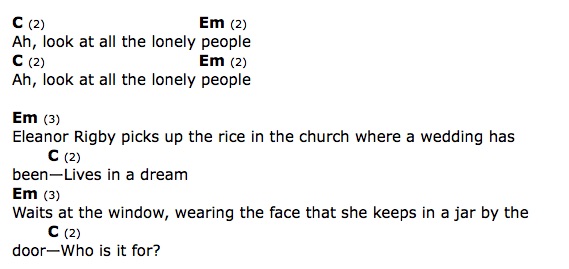
Rigby chords

Heartwoodguitar.com

I began with several different ideas, playing around with a Travis-picked D/Am progression but dropped it in favour of something a bit more bouncy that moves between the I and the IV (‘C#’ and ‘F#’).  This gave me a bit more to play with in terms of the interaction between the melody, lyrics, chord changes.

For the pre-chorus I make a slight change by holding on the IV for an extra bar before returning to the riff.    It isn’t quite the same as reversing the order but it does briefly shift the emphasis to the IV and breaks up the pattern.

I also drew on my Pat Pattison theory of songwriting and made subtle changes to the way the lyrics are set between the verses and choruses, “leaning forward” in the chorus to give it a bit more emphasis and remain consonant with the thematic shift in the song.

When I arrived at the end of the second chorus it felt like the song needed a bridge of some kind, so I changed up the rhythm and used a lower and more open voicing of the IV chord:

F chord

Capo 1

The lyrics, as often is the case for me, started out largely as muttered gibberish but slowly evolved into a reasonably unified theme.  I find the process of just singing nonsense, recording it as a series of takes, and then listening back to it generates lots of interesting and unexpected ideas.  Often the gibberish singing produces longer, more rhythmic lyrics than I might otherwise come up with.  Revising it all and giving the song a coherent meaning can be difficult but it usually comes together after a couple days.

FullSizeRender

Lyric worksheet for “Shine On Young Heart”


The Result

Shine On Young Heart

She picks me up in the morning light-
She knows what she’s doing
But for the dust on the heels of my cowboy boots-
I came home with nothing

She dreams of a season scented-
With suntans and Fridays
Sayin’ life is like a long ride in a limousine-
Just lean back and enjoy

She knows just the thing to say-
She puts my mind at ease that way-
It’s a brand new day-
We’ll watch the children play-
You know the sun is here to stay-
Shine on young heart

When I turn back, lose track keeping time-
Choking with fear
She’s there with that halo in her hair-
And whispers for my tears

She knows just the thing to say-
She puts my mind at ease that way-
It’s a brand new day-
We’ll watch the children play-
You know the sun is here to stay-
Shine on young heart

I know you love me

She knows just the thing to say-
She puts my mind at ease that way-
It’s a brand new day-
We’ll watch the children play-
You know the sun is here to stay-
Shine on young heart

(Copyright 2016 Gordon Gow)


Sneak preview

Here’s a little taste of what’s coming on the EP. This is a rough mix done shortly after we recorded it at Maggie’s Hill cabin in April.

The song received a Special Mention in the 2016 Ship & Anchor song contest in Calgary for the Jameson Upstart Category.

Recording at Maggie’s Hill cabin near Edmonton

We had a big weekend, recording lead vocals for five songs and backup vocals for another four songs.  Maggie’s Hill cabin is a historic site just east of Edmonton.

The cabin was built by a Metis settler in 1891 and provides a blissful location for creative work.  My producer Everett LaRoi and I were joined by his sister Renee, as well as Alice Kos and Karen von Klitzing who both provided backup vox for the record.

IMG_1041

Song Forms Part 1: Verse/Chorus

Modernist designers introduced the notion that form follows function to suggest that the intended purpose or function of any object should dictate its shape or appearance.

For songwriters, this is an important idea because it draws attention to the musical form that we use to provide a structure for our compositions.  If we assume that the hook is the heart of a song (it doesn’t seem right to call it the ‘function’) then the form should follow in such a way that best supports that hook.

There are always exceptions to the rule, but Sheila Davis in The Songwriters Idea Book offers a helpful overview of the three major song forms that have tended to dominate in the field.  This is changing with genres like rap and EDM but let’s ignore that for now.
music in the late afternoon sun

The three major forms are the verse/chorus, the AABA, and the AAA.  Each has several variations, but basic idea is that these forms support different kinds of hooks.  Let’s focus on the verse/chorus form for now and I’ll discuss the others in future posts.

The verse/chorus form is very common and well suited to songs that have a strong hook that can stand on its own with a lyric and melody that bears repeating.  The verses support the hook by using a variety of approaches including plots based on time, place, point of view, etc.  The sections are usually very distinctive, with most listeners able to easily identify the difference between a verse and a chorus.  Very often the title of the song is the first line of the chorus in this form.

A good contemporary example of this form is found in “Beautiful Day” by Charlie Robison.  The song includes a lengthy 16-bar instrumental break after the second chorus before continuing to a third verse/chorus.  (Amazingly, however, the song still comes in under 3 minutes, ensuring it is radio friendly.)

A common variation of the verse/chorus form is to include a bridge after the second chorus that provides musical contrast to both the verses and the chorus.  The song form looks like this:  Verse/Chorus/Verse/Chorus/Bridge/Chorus.  Sometimes there is a short instrumental break after the second chorus and before the bridge.

A good classic example of this form is Bryan Adam’s “Cuts Like a Knife“.  The 8-bar bridge is placed after the guitar solo and with the lyric starting “Another night/another lesson learned”.  The chorus then follows and ends the song.

A second common variation is the verse/climb/chorus, which adds a pre-chorus or ‘climb’ in between the verse and the chorus.  This form is used to build up energy for the release of the hook, or sometimes to provide an important lyric line that helps to set up the chorus.

A good contemporary example of this form is JP Hoe’s “Save You“.  The climb after the first verse begins with the lyric “so tell me where did it go wrong..” with the chorus starting on the line “You tried to own the sun …”.  The climb in this case is essential to a plot twist in the lyric (listen for it).  It’s interesting to note that the title is buried in the chorus, but in my opinion the musical hook is so strong that it doesn’t matter all that much.  It’s also worth mentioning that the song has a bridge-type section based on the both the music and lyrics of the climb section.

Form follows function, and for songs with strong, repeatable standalone hooks, the verse/chorus structure is both effective and often anticipated by listeners.  In the next part I’ll talk about the slightly more elusive AABA form.


Tacoma ER22C SJ by brett jordan

Preproduction session 5: get back (to where you once belonged)

Tracking will start on the record in January but the last preproduction session of 2015 was about continuing to run songs and exploring ideas for arrangements.

One important point that came out of the conversation was about capturing the essential energy of a song, and how that energy changes as a song evolves from a seed into a demo and beyond.  Sometimes the seed of the song captured on a smartphone or a scratch track has a liveliness to it that slowly disappears as it is massaged into a more complete piece and arrangement.

As a result there are times when it may be helpful to scrap the demo version and go at a song fresh in order to re-energize it and bring back the sparkle of that first blush of an idea.

Philosophers and anthropologists talk about liminality, that moment of first encounter with something new and unknown.  It’s a notion that captures the idea of a threshold, of disorientation, of radical potential.  The liminal energy of a new song is vital, and trying to bring it out in a record is a priority if the track is to come alive for the listener.

Studio LaRoi empty_Dec. 20_2015

Everett LaRoi’s home studio where we will be recording in January

One of the tracks planned for the record, “Meet me in Montreal” has been indelibly etched in my mind with an arrangement I cobbled together for the first demo of it.

Everett and I had an important conversation about that song yesterday, discussing the idea of departing from that demo version and taking it in a brand new direction from a production standpoint.

And while the demo version is familiar and has some good ideas in it, I’m totally okay with trying something new as a way to recover that liminal energy and inject into it some outside creative influences.  I realize that it’s not quite a tabula rasa but it is more about returning to that original place of inspiration … or getting back to where I once belonged.


Preproduction session 4: the sound of silence

This session we continued to run songs, discussing structure and arrangement.  One of the important considerations as we begin to imagine the songs in production is the balance between sound and silence.

Context, as they say, is everything, and learning how to use silence to frame a melody and lyric can really bring out the most in a song.  One proverb I came across sums it up well: words are silver but silence is golden.  We frame the words with silence.  Silence makes it sing.

FullSizeRender

Everett and I running songs in his studio

In any case, working in the modern digital studio with hundreds of gorgeous sounds at your fingertips makes it very tempting to fill up the silence with a rich but unnecessary arrangement.

We know this and so we’ve been talking about how to strike a balance in the songs that will give them an interesting sonic texture that brings out the most of the melody and the lyrics.  A golden frame for silver words, as it were.  When does the lap steel come in?  At the beginning or in the second verse?  Does it play throughout, or only at one or two points in the song?  Should we have backup vocals in this part?  What about a tone wheel organ?  Or nothing.  Just a single note the guitar maybe.  So many possibilities.

From a production standpoint, one approach may be to try out lots of different ideas and explore options before making decisions and stripping it to the essentials.  But this still comes down to a subjective decision in the process, and one where experience and a sense of discipline will pay off in the end.


https://www.flickr.com/photos/39747297@N05/5230479916/in/photolist-8Yczsd-cbcCk3-7jNmHv-dipm3P-5FefTX-sKjX3-5Fixk1-bBUjs2-bCwEoZ-4qLmk2-ccHti1-bUswQr-2Nati-eALvw3-5bjaoE-dULRxt-boZz85-daMjCh-5FivxU-nfWQif-bEU9xB-evy1D8-78WDg-3f6kZz-bQ7zsp-5FefXP-ddus1V-dwHLRn-5FiwF3-3Ao8mS-9NCMZT-5EYCfm-cpXBxm-e48NRC-8h9176-bBUupB-jvie5t-jjWWL7-2BS8QV-2pvf6Z-4ZHLs3-5WnYcr-422k5w-63dWbv-fbyEfd-oJsYJa-bxN9YA-fSNt1b-dURTpS-3AEivQ

Preproduction Session 3: Steel sings and fat gets trimmed

Everett and I met on Sunday for our third preproduction session.  This time we set up some mics and did some initial tracking with vocals and acoustic guitar.  Everett has recently acquired a Gretsch lap steel, and we used this opportunity to explore ideas for the song “Longest Night of the Year”.

When he first tried out the slide guitar during the bridge of the song, it was almost a transcendent moment for me.  Not having heard much beyond acoustic guitar versions of the song so far, even this small contribution to the arrangements was amazing.  It was like putting butter on the bread.  The trick now will be to figure out how much of that slide guitar will be just right without overdoing it.

Everett with lap steel annotated

While we spent a good part of the session exploring possibilities for the lap steel, I also began to take a hard look at the structure of this song and what might be trimmed to tighten it up.  The initial version was coming in at over 6 minutes, which is too much to keep a listener interested–at least for this kind of folky acoustic song.  So, we’ve started to trim and clip some of the excess.  It is always remarkable to see how much better a song can be when the fat is cut from it.  And while the length of a song should not always be a determining factor, it is an important consideration especially when a first draft of the song exceeds five minutes.

In this case, the song structure revolved around a Verse/Chorus/Verse/Chorus/Verse/Bridge/Verse/Chorus, which when you look at it written out does seem kind of excessive.  And that isn’t taking into the account that the verses are structured around 3 stanzas as opposed to the usual 2 stanzas.  Anyway, we can often write a lot when a song is in its early stages and we’re not sure what is really important to the lyric or the flow of the song.  That’s not bad inasmuch as it gives us lots of material to work with.

However, having some distance from it now (I wrote the original song in March/April), it has become easier for me to take a critical view and cut out a stanza in the second verse, remove the verse before the bridge, and drop the chorus at the end altogether.  (I realize that dropping the last chorus might seem unusual but it works because the last verse is a repeat of the opening stanza, creating a cyclical effect with a sense of instability in the ending, which corresponds with the mood I want).  The net result has been to bring the length to under 5 minutes and arrive at a song structure that will be more likely to hold the listener’s attention.

I’m learning that the songwriting continues well into the preproduction phase, as lyrics get revised and song structure gets reworked.  I’m also realizing that it’s a lot easier to do some of this when I have some critical distance from the song, which suggests the value in coming into the studio with material that maybe isn’t too freshly minted.

https://www.flickr.com/photos/39747297@N05/5230479916/in/photolist-8Yczsd-cbcCk3-7jNmHv-dipm3P-5FefTX-sKjX3-5Fixk1-bBUjs2-bCwEoZ-4qLmk2-ccHti1-bUswQr-2Nati-eALvw3-5bjaoE-dULRxt-boZz85-daMjCh-5FivxU-nfWQif-bEU9xB-evy1D8-78WDg-3f6kZz-bQ7zsp-5FefXP-ddus1V-dwHLRn-5FiwF3-3Ao8mS-9NCMZT-5EYCfm-cpXBxm-e48NRC-8h9176-bBUupB-jvie5t-jjWWL7-2BS8QV-2pvf6Z-4ZHLs3-5WnYcr-422k5w-63dWbv-fbyEfd-oJsYJa-bxN9YA-fSNt1b-dURTpS-3AEivQ

Preproduction session 2

Everett and I are continuing to run songs and explore ideas for the upcoming record.  Here we are in his home studio working on parts for “You, Me, and the Almighty.”  At this point, most of our effort is focussed largely on playing the songs together, listening to them in a raw form, and then talking about structure and arrangements.

For this song, we’ll likely keep things relatively simple with guitars and possibly a slide steel.  I’m keen to try out some unusual sonic elements to give the song a darker quality, and Bry Webb’s album Freewill is something we’re listening to for ideas.

Photograph by Renee LaRoi Design.

IMG_5583 (1)

Experimenting with video

So I tried out a little experiment with video a few weeks ago.  The song is the demo version  of “Meet me in Montreal.” I wanted to know if I could assemble something from found footage on YouTube that touched thematically on the song.

The lyric alludes to a road trip taken sometime in 1967, so I looked for old super 8mm footage from Expo 67 and other home movies of that time period.  I used Savefrom.net to capture and download the videos as mp4 files, which I then imported into iMovie.  I’m not a filmmaker (as some viewers will no doubt immediately recognize) but it was fun to find and edit the footage into something that accompanies the song demo.

I think it turned out okay and it shows what can be done on a tight budget with a bit of creativity.  I’m not sure about the intellectual property questions it might raise but I confined my sources to home movies that don’t appear to have any commercial value or intent.  However, for good measure I did include a link to each of the source videos on the Vimeo page.