Working the Body Language of a Song (Part 3)

This is the third in a series of postings about the body language of a song.  I first heard that term from songwriting consultant Pat Pattison, who uses it in reference to lyric setting.  In my previous post I described Pattison’s concepts of front and back heavy lines in relation to creating stability or instability in a song.

A key lesson in all this is to ensure that the lyrics are set against the music in a way that delivers maximum intended impact.  As Pattison correctly observes, what we say is often less important than how we way it.  Setting a lyric to music is about how we deliver the words.

I’ve started to use a worksheet method to help me analyze my own writing and, hopefully, to improve the setting of my lyrics by paying attention to front and back heavy emphasis.
IMG_0348 IMG_0346 

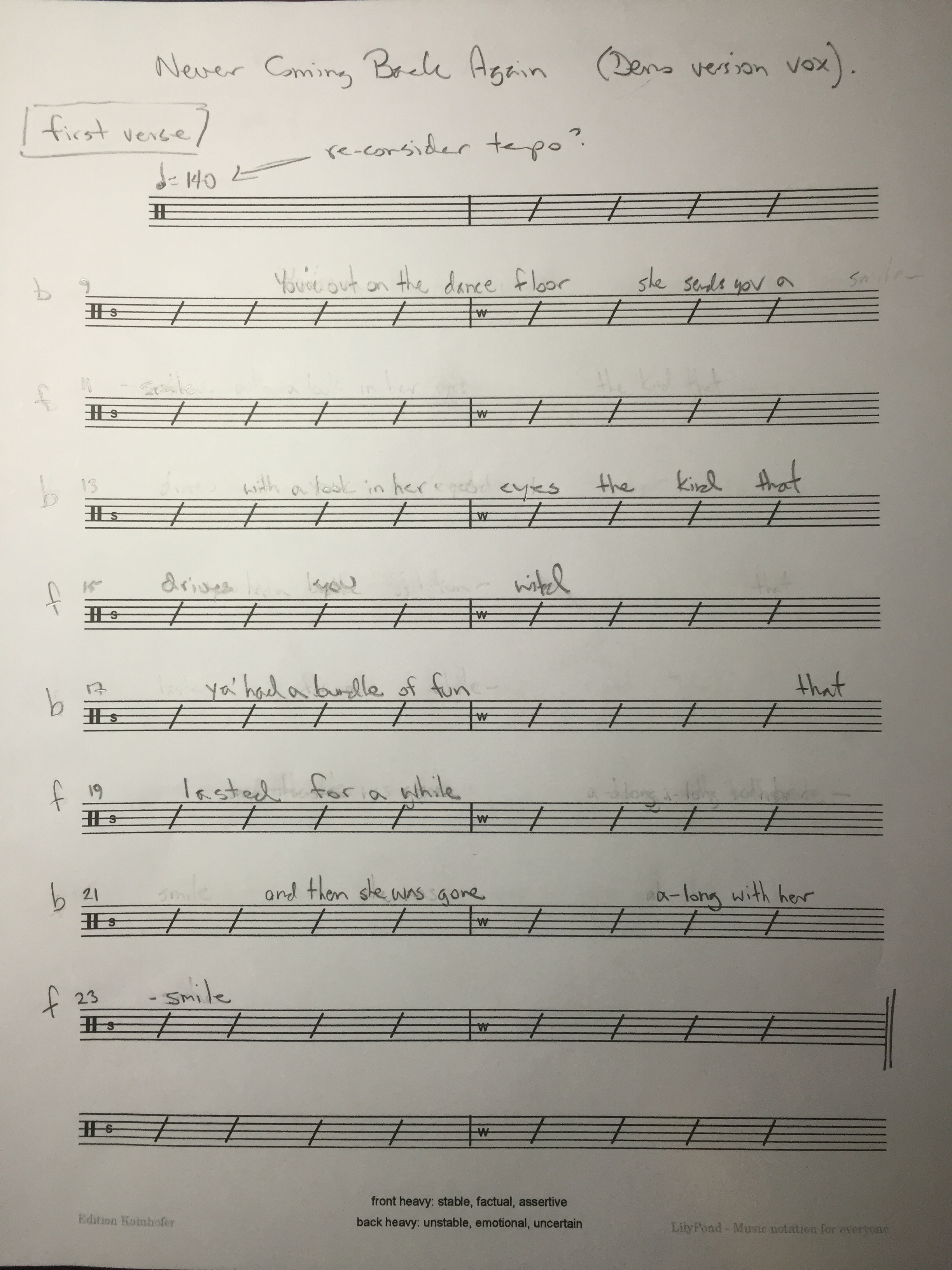
The worksheets use a single stave drum clef divided into 2 measure per row, each with slashes representing each downbeat in the bar.  When working with my DAW, I also note the measure number of the lines to help me locate it on the recording.   After I’ve recorded a performance of the song I go back and analyze it, transcribing the lyrics using the worksheet.

In the example above, the version on the left is the lyric as originally set in the demo recording.  I wasn’t happy with it and felt that it wasn’t well set with the music.  When I transcribed it using the worksheet I realized that the phrasing was predominantly back heavy (in the margin I wrote ‘f’ and ‘b’ to mark front and back heavy).

The song lyric is about letting something good slip through your hands and the importance of taking advantage of opportunities when they present themselves. The verse begins with words that paint a picture of thrill and excitement so it lends itself to front heavy emphasis because the first part of the verse is really a series of assertive, stable statements.

However, the mood becomes unstable in the last two lines as the opportunity slips away.  So, for the last two lines I opted for back-heavy to contrast with the front-heavy lines and to help better convey that sense of instability that is inherent in the words.

The worksheet on the right shows the lyrics after I made some changes to the way the lines are set.  You will notice that all the lines are now set front-heavy except the last four measures of the verse, which adds contrast and instability leading into the chorus.

Incidentally, these changes also required me to rewrite some of the lyrics (the revisions never end!) but that actually helped me to improve some weak spots that had been nagging at me.  (However, you will note also the pink Post-it Note identifying what I think is still a weak line that needs more work).

The worksheet is one technique but the main point is to think about the body language of the song and to use front and back heavy setting as a method to better align the ‘what’ you sing with the ‘how’ you sing it.

Working the Body Language of a Song (Part 2)

My last post introduced Pat Pattison’s songwriting theory of stability/instability and I compared it to consonance/dissonance in music composition.  Good writing, I suggested, is when we intentionally design both stable and unstable elements into a song to convey an intended emotion to our listeners.

Pat Pattison’s songwriting method offers an interesting way to apply the concept of stability/instability when we set words to music.  He refers to this as the ‘body language’ of a song and, rightly, points out that most of our communication is non-verbal in nature.  In other words, how we say or sing something is probably more important than the actual words we are saying or singing.

Pattison uses the terms ‘front heavy’ and ‘back heavy’ when he talks about stability/instability with the setting of lyrics to music with this fundamental distinction:

  • Front heavy phrasing is stable
  • Back heavy phrasing is unstable

So what does he mean?  Front heavy phrasing emphasizes key words on strong beats.  In 4/4 time, that means the first and third beats of a measure.  Back heavy phrasing places key words on weak beats.  In 4/4 time, that means the second and fourth beats.  In practice when we sing, the placement might not be exactly on a beat but the idea here is a rough guideline.

Front heavy phrasing is called for when we want to convey a sense of being assertive, confident, factual.  Back heavy phrasing is called for when we want to convey a sense of uncertainty, loss, trepidation.  Used in combination, the two techniques can be subtle but powerful when aligning the body language of you song with with the content of the lyric.  Pattison’s demonstration of it in action (see link above) is quite revealing.

I’ve applied it to my own writing and I am becoming convinced that there is definitely something to this approach that improves my songs.  Not only that but it gives me a helpful tool for analyzing my lyric setting especially when something just doesn’t sound right to my ears.  By examining the placement of my lyrics in relation to front/back heavy emphasis, I find I can make more informed decisions when I want to make changes to the song.

In the next post I’ll share a worksheet technique that I’ve developed for analyzing the body language of my songs.

Working the Body Language of a Song (Part 1)

Pat Pattison is a professor at the Berklee College of Music and a widely respected songwriting coach and mentor.  I’ve written about his approach to songwriting before and find it a helpful way to approach the process most especially during the revising and polishing stage of writing.

If I were to identify two key ideas that inform his approach to writing better songs they would be these:

  1. prosody
  2. stability/instability

I’ll talk more about Pattison’s notion of prosody in a future post but for now I want to focus on his second idea of stability/instability.  The idea is closely related to the notion or consonance/dissonance in music (or tension/release in other forms of writing).  Depending on the intended emotional effect of a piece of music, as writers we want to be aware at all times whether the idea or expression has the quality of assertiveness (stable) or uncertainty (unstable). 

More importantly, we want to be able to use techniques that help our writing to convey these qualities in effective combinations.  In other words, we want to design both stable and unstable elements into our songwriting.

The simple I-IV-V formula for blues progressions is an example of these two elements in a time-honored combination.  It begins with the tonic (I) chord, moves to the subdominant (IV) chord creating a sense of movement (slightly unstable), then back to the dominant (stable), then to the subdominant briefly before heading to the dominant (V) chord (unstable).  With the dominant (V) chord, instability/tension is at its maximum and it resolves satisfyingly back to the stable tonic (I) chord.  It’s like a journey that takes us away and brings us back home.

Many songwriters already understand this aspect of music composition but some like me hadn’t thought about applying it when we set words to music.  And that’s where Pat Pattison’s notion of ‘body language’ in lyrical phrasing comes into play.

More about that in the next posting.

Let’s make a record

I’m excited to be starting work on my first record with Edmonton-based musician and producer Everett LaRoi.  We will be setting up the production schedule soon and should have a record ready to release sometime next year.

I’m going to take my time and enjoy the process, so we haven’t set ourselves any hard deadlines.  Right now we’re planning on recording a 6-song EP.  We’ve got a shortlist of songs and will get started on pre-production in October with Spicy Tomato Music.

Everett is a really interesting guy with lots of song writing and performance experience stretching back to the mid-1980s with his former band Idyl Tea.  His recent production credits include work with ManRayGun, Goldtop, and Alice Kos.  It’s a real honour to have him be a part of the Selkirk Range project.

Uptown Folk Club

This is a highlight reel from a short set I did at the Uptown Folk Club in Edmonton last week.  The Club plays a valuable role supporting live music and songwriters in the city and they have an open mic one Friday each month, which is a great opportunity to try out new material in front of a friendly audience.

Getting the record together: budget time

Now that I’m contemplating a self-released album or EP, I need to think about the inevitable costs.  Like any other project it’s important to think through the details because, well, that is where Devil lives.  In those details.  To help me work through this process, I’ve drawn on a great resource online for artists looking to release their own record.  Among other things, there is a link to a resource on creating a budget.

Categorically, the costs divide up into (1) music production and recording; (2) artwork and packaging; (3) marketing and promotion; and (4) “other” expenses, which include online distribution. I’ll start to work my way through these and share some of the details in upcoming posts, including any additional resources I might come across.

https://www.flickr.com/photos/39747297@N05/5230479916/in/photolist-8Yczsd-cbcCk3-7jNmHv-dipm3P-5FefTX-sKjX3-5Fixk1-bBUjs2-bCwEoZ-4qLmk2-ccHti1-bUswQr-2Nati-eALvw3-5bjaoE-dULRxt-boZz85-daMjCh-5FivxU-nfWQif-bEU9xB-evy1D8-78WDg-3f6kZz-bQ7zsp-5FefXP-ddus1V-dwHLRn-5FiwF3-3Ao8mS-9NCMZT-5EYCfm-cpXBxm-e48NRC-8h9176-bBUupB-jvie5t-jjWWL7-2BS8QV-2pvf6Z-4ZHLs3-5WnYcr-422k5w-63dWbv-fbyEfd-oJsYJa-bxN9YA-fSNt1b-dURTpS-3AEivQ

Tracking your digital song files with the ISRC

I’ve embarked on a learning journey as I begin preparations for making a record.  Among the things I’m learning is the ISRC (International Standard Recording Code) is the system for royalty collection with digital song files.  The ISRC is a 12-character identifier associated with each unique song, that allows it to be traced back to the owner for royalty payments.

The code consists of a 2-digit country code, registrant code, year of reference, and designation code.  For Selkirk Range the code for the first song on the record will probably look like this:  CAX0V1600001, where “X0V” is my registrant code and identifies me as the independent artist that owns the rights to the song.  “CA” is Canada, and “16” is the year I expect to release the song (2016).  The designation code 00001 might be the first song on the record.

The owner assigns the codes to the songs and includes them with the metadata of the files as well as the master CD.  The owner also provides them to agencies that need them for tracking and paying royalties (e.g., iTunes, CD Baby, etc.).

There is no cost for obtaining an ISRC Registrant Code and it’s quick and painless. As an independent artist you will likely have to do this yourself.  Each country has its own domestic organization that administers the ISCR, and in Canada it is Connect Music Licensing.  You can learn more about Canadian ISRC administration here.

More on simplicity and songwriting

The Glenn Morrison/Islove song “Goodbye” is a current example of success through simplicity.  It contains a strong melodic hook with a compelling visual image as the centrepiece: “…and it starts to snow in the streets of Mexico.”

It’s one of those lines that I can imagine a songwriter just blurting out as they play through the chord progression and then realizing they are on to something interesting.  The winning element here is that Morrison didn’t bury that line in complexity but chose to showcase it with a catchy and infinitely repeatable melody.

The song itself is a common chord progression (Am/F/G/Am) with only the addition of the C (Am/F/C/G) to create contrast between the opening verse and the lead up into the chorus.

From a production standpoint, however, there is quite a bit going in this song.  I suppose that’s the caveat to Gary Ewer’s comments about simplicity and success.  Dressing a song up for contemporary hit radio is perhaps the producer’s art form.  The right tempo, the right drum track, the sound textures (including Morrison’s use of a sample from “Every Breath You Take”), the perfect vocal performance, etc.

Simplicity is one thing.  Making the most of the song for the intended audience, especially contemporary hit radio, can be a very complicated and delicate undertaking indeed.

Capital City Records in Edmonton

This is a great initiative to support local talent in Edmonton.  The Edmonton Public Library has launched a program called Capital City Records to establish a public digital space to celebrate the local music scene and its history.

Anyone can stream the albums but if you have an EPL library card you can also download the tracks.

They plan to add 100 albums per year, with the call for the next round of submissions coming up this Fall.

Musical Simplicity and Success Often Go Hand In Hand

Gary Ewer’s blog is a great resource for songwriters. Among other things, he offers these important reminders about keeping things simple.

garyewer's avatarThe Essential Secrets of Songwriting Blog

How to Harmonize a Melody eBook - Gary Ewer

Cold War Kids - FirstIt’s a common error to think that imaginative music comes from musical complexity. The thought is that if you write music that uses intricate chord progressions, elaborately entangled melodies, all partnered with bewildering lyrics, you’ve got something that should stimulate the imagination of the listener.

But usually, that kind of music just ends up confusing the listener, boring them, and ensuring that they won’t bother listening again.

In fact, simplicity is the most valuable quality of good songwriting. Simplicity, in this context, simply means that the listener can hear and understand each element of a song. What generally stimulates the imagination and stirs the interest of the listener is how those elements all connect.

American indie rock band Cold War Kids’ latest album, “Hold My Home,” is a great album for demonstrating the notion of creating music that easily grabs listener interest by layering elements that are clean, clear and transparent.

Considering their song…

View original post 393 more words