Blue December: The tradition of sad holiday songs

Holiday music isn’t all sleigh bells and sentimentality. Alongside the familiar standards runs a quieter, older tradition: the sad holiday song.

From Elvis’s Blue Christmas to Joni Mitchell’s River, these tracks acknowledge a truth the season often glosses over—this time of year can sharpen loneliness just as easily as it inspires joy. They’re songs built on absence, distance, and the emotional weight that settles in when everyone else seems to be celebrating.

That tradition was the starting point for me when I wrote ‘Longest Night of the Year (Christmas Tears)’, a song rooted firmly in an Alberta experience.

The story follows a father working in the northern oilsands, alone on a subarctic winter night. Temperatures push past minus forty. The sky is clear enough to see the aurora cutting across the horizon. From the cab of his truck, he watches the lights and thinks of home—of the family he’s providing for but can’t be with.

This new Sunophonic regeneration leans into the grit of the story. The vocal is rougher, more expressive. The arrangement folds into a folk palette, with a big sounding middle section that settles into the final refrain.

I think this new arrangement really suits the moment and the landscape—dark, cold, and brutally honest.

🛣️ Queen E ⛰️

Ever been on a winter road trip where the landscape is the soundtrack? That’s ‘Queen E’ — written with that Alberta highway in mind. Heading south out of Calgary, the Rockies sit to the west in the distance, growing closer as you drive toward the U.S. border.

Fort Macleod is on the map, Ian Tyson and Corb Lund country, with four strong winds carrying the sounds of open prairie. It’s Canadiana: endless highway, where ‘the blacktop meets the blue’ horizon, and with mountains rising like a castle of stone.

Near De Winton, Highway 2A splits to the southwest, connecting Calgary to Okotoks.
Alberta Highway 2 – exit 222 by Marek Ślusarczyk 

🎧 Listen, like, and share Queen E on Spotify, Apple Music or your favourite streaming platform.

✨ This Might Be Love ✨

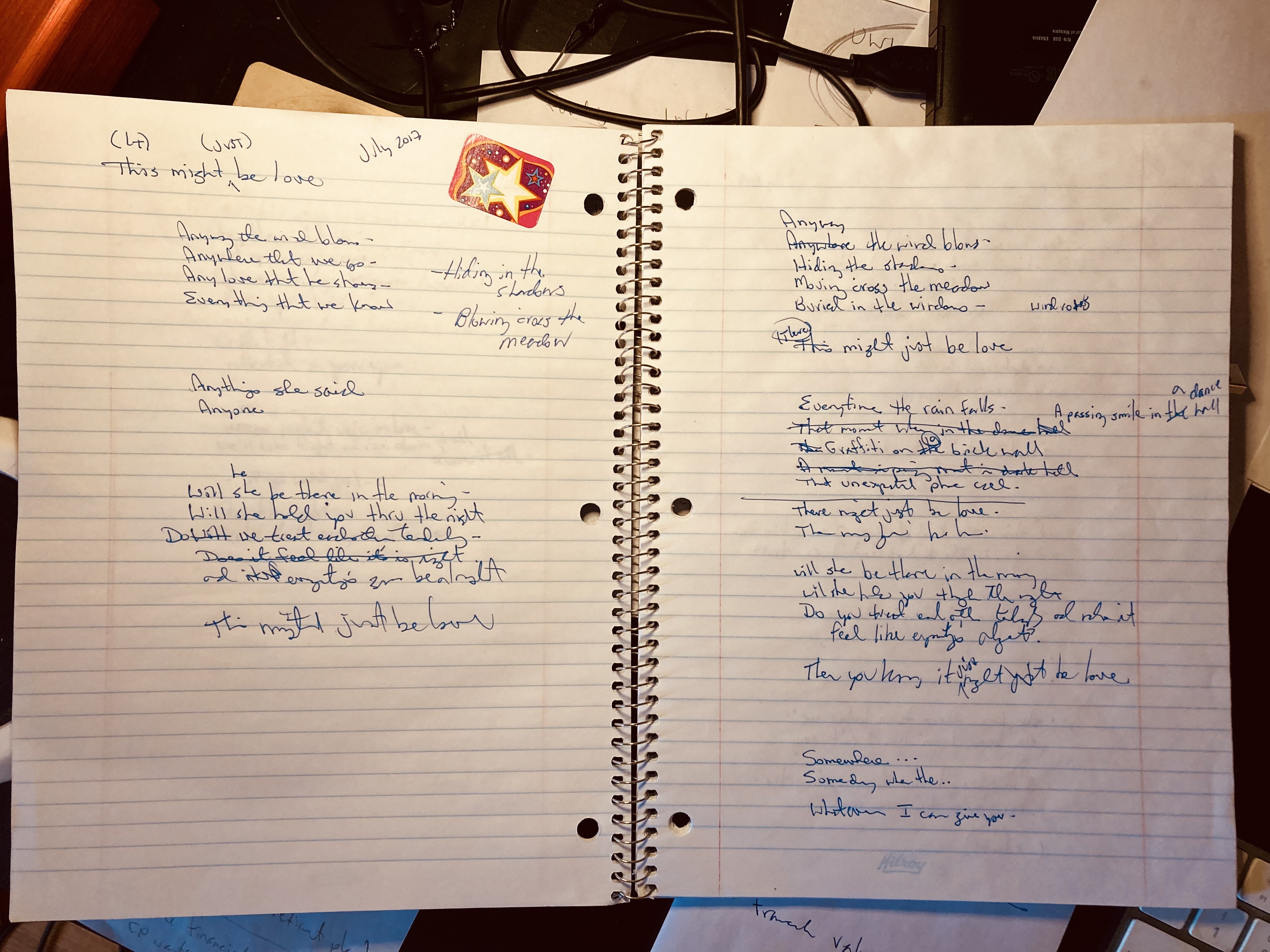
One of the songs closest to my heart from the Hired Gun album is ‘This Might Be Love‘. To give you a glimpse into the process, I’m sharing an image of the handwritten lyrics—the very first draft where the song took shape back in July 2017.

You’ll notice a little star sticker on the page—that’s my own reward system. Whenever I finish writing a song, I give myself a star. It’s a small ritual, but it makes the creative process feel like a celebration. 🌟

It’s a reminder that every track starts as words on a page before it grows into music.

I’d love for you to check it out—listen, like, and share This Might Be Love on Apple Music, Spotify, or wherever you stream your music. Every click and share helps bring these songs to more ears. 🎶

Introducing the Sunophonic Sessions

I’m excited (and, truthfully, a little nervous) to share a new chapter in the Selkirk Range project: The Sunophonic Sessions.

This collection of songs is built around something I hold sacred—words. Every lyric in this forthcoming collection of songs is my own, written by hand over many months and years. That part of the music—the storytelling, the voice behind the voice—is something I feel strongly about preserving. These are my stories, my images, my turns of phrase.

What’s new is how they’ve been brought to life in musical form.

The arrangements and performances you’ll hear weren’t created in a traditional studio. They were rendered using Suno.ai, a generative music platform that transforms lyrical and stylistic prompts into fully realized musical performances. At first, I was unsure—skeptical, even. I wondered whether it could really feel anything like music made with people in a room.

But what surprised me was just how responsive it is. Suno can infer mood, phrasing, and even expression in ways I didn’t expect. The platform—still early in its evolution—has a remarkable knack for giving voice and shape to a song. Quite frankly, it’s been a thrill to hear these words set to music like this.

Over the past decade, I’d written some two dozen songs that have been sitting in a collection of notebooks and pre-production demo recordings. As I began shaping them with Suno, they seemed to naturally split into two distinct sounds: one leaning into country traditions, the other into more adult-oriented folk-pop. The result is the Sunophonic Sessions, which will be released across a single and two albums:

  • The Ballad of the Titan is available on Bandcamp now and will be released on the other streaming platforms soon. It’s a slightly quirky take on the ill-fated OceanGate submersible, playing on the connection between the words Titan, Titanic, and Atlantic. You can read more about it in my earlier post.
  • Hired Gun, arriving on August 22 has something of a classic country feel, pairing plainspoken storytelling with easygoing melodies. I brought in Colin Noel from Electric Treehouse studio to add final polish to the mixes and mastering of this collection.
  • Duty. Courage. Truth. will follow later this year, exploring an adult contemporary sound with folk-rock at its core. Textured arrangements and reflective themes move across a range of moods, from intimate to anthemic. You can hear a pre-release version now on Bandcamp — and while you’re there, follow Selkirk Range to get updates and be the first to know when the album drops.

Above all, the greatest reward for a songwriter is finding an audience who feels the words and emotions you’ve poured into a song. In that sense, how the music was produced matters far less than whether it connects. Hearing these songs come back polished and expressive has been like hearing them for the first time — a mind-blowing experience for a songwriter working with limited resources. The tools may have changed, yet the intent remains the same: to create songs that are meaningful, and to offer them with the hope they’ll find a home in someone’s heart.

Thanks for listening.

– Gordon (Selkirk Range)


Look out for the first releases from Hired Gun and Duty Courage Truth coming soon.

The Ballad of the Titan

This song started with a simple wordplay: Atlantic, Titanic, Titan. That connection stuck with me, and I wrote the chorus months ago, long before the verses. I was drawn to the interplay of those names, their inherent rhythm, and the tragic resonance between them:

The Atlantic took Titanic-
Which lured the Titan down-
To the bottom of the sea

As part of my ongoing Sunophonic sessions—an artistic exploration of generative AI in songwriting—I sung the melody into Suno then pasted my lyrics, and wrote a simple prompt: “sea shanty, ballad.” It generated several versions, one of which uncannily matched my vision for the song. This is what makes working with these tools so captivating.

The result is a somber ballad in the tradition of maritime storytelling, akin to Gordon Lightfoot’s “The Wreck of the Edmund Fitzgerald”—a cautionary tale for a modern tragedy.

Song Forms Part 1: Verse/Chorus

Modernist designers introduced the notion that form follows function to suggest that the intended purpose or function of any object should dictate its shape or appearance.

For songwriters, this is an important idea because it draws attention to the musical form that we use to provide a structure for our compositions.  If we assume that the hook is the heart of a song (it doesn’t seem right to call it the ‘function’) then the form should follow in such a way that best supports that hook.

There are always exceptions to the rule, but Sheila Davis in The Songwriters Idea Book offers a helpful overview of the three major song forms that have tended to dominate in the field.  This is changing with genres like rap and EDM but let’s ignore that for now.
music in the late afternoon sun

The three major forms are the verse/chorus, the AABA, and the AAA.  Each has several variations, but basic idea is that these forms support different kinds of hooks.  Let’s focus on the verse/chorus form for now and I’ll discuss the others in future posts.

The verse/chorus form is very common and well suited to songs that have a strong hook that can stand on its own with a lyric and melody that bears repeating.  The verses support the hook by using a variety of approaches including plots based on time, place, point of view, etc.  The sections are usually very distinctive, with most listeners able to easily identify the difference between a verse and a chorus.  Very often the title of the song is the first line of the chorus in this form.

A good contemporary example of this form is found in “Beautiful Day” by Charlie Robison.  The song includes a lengthy 16-bar instrumental break after the second chorus before continuing to a third verse/chorus.  (Amazingly, however, the song still comes in under 3 minutes, ensuring it is radio friendly.)

A common variation of the verse/chorus form is to include a bridge after the second chorus that provides musical contrast to both the verses and the chorus.  The song form looks like this:  Verse/Chorus/Verse/Chorus/Bridge/Chorus.  Sometimes there is a short instrumental break after the second chorus and before the bridge.

A good classic example of this form is Bryan Adam’s “Cuts Like a Knife“.  The 8-bar bridge is placed after the guitar solo and with the lyric starting “Another night/another lesson learned”.  The chorus then follows and ends the song.

A second common variation is the verse/climb/chorus, which adds a pre-chorus or ‘climb’ in between the verse and the chorus.  This form is used to build up energy for the release of the hook, or sometimes to provide an important lyric line that helps to set up the chorus.

A good contemporary example of this form is JP Hoe’s “Save You“.  The climb after the first verse begins with the lyric “so tell me where did it go wrong..” with the chorus starting on the line “You tried to own the sun …”.  The climb in this case is essential to a plot twist in the lyric (listen for it).  It’s interesting to note that the title is buried in the chorus, but in my opinion the musical hook is so strong that it doesn’t matter all that much.  It’s also worth mentioning that the song has a bridge-type section based on the both the music and lyrics of the climb section.

Form follows function, and for songs with strong, repeatable standalone hooks, the verse/chorus structure is both effective and often anticipated by listeners.  In the next part I’ll talk about the slightly more elusive AABA form.


Tacoma ER22C SJ by brett jordan

Preproduction session 5: get back (to where you once belonged)

Tracking will start on the record in January but the last preproduction session of 2015 was about continuing to run songs and exploring ideas for arrangements.

One important point that came out of the conversation was about capturing the essential energy of a song, and how that energy changes as a song evolves from a seed into a demo and beyond.  Sometimes the seed of the song captured on a smartphone or a scratch track has a liveliness to it that slowly disappears as it is massaged into a more complete piece and arrangement.

As a result there are times when it may be helpful to scrap the demo version and go at a song fresh in order to re-energize it and bring back the sparkle of that first blush of an idea.

Philosophers and anthropologists talk about liminality, that moment of first encounter with something new and unknown.  It’s a notion that captures the idea of a threshold, of disorientation, of radical potential.  The liminal energy of a new song is vital, and trying to bring it out in a record is a priority if the track is to come alive for the listener.

Studio LaRoi empty_Dec. 20_2015

Everett LaRoi’s home studio where we will be recording in January

One of the tracks planned for the record, “Meet me in Montreal” has been indelibly etched in my mind with an arrangement I cobbled together for the first demo of it.

Everett and I had an important conversation about that song yesterday, discussing the idea of departing from that demo version and taking it in a brand new direction from a production standpoint.

And while the demo version is familiar and has some good ideas in it, I’m totally okay with trying something new as a way to recover that liminal energy and inject into it some outside creative influences.  I realize that it’s not quite a tabula rasa but it is more about returning to that original place of inspiration … or getting back to where I once belonged.


Preproduction session 4: the sound of silence

This session we continued to run songs, discussing structure and arrangement.  One of the important considerations as we begin to imagine the songs in production is the balance between sound and silence.

Context, as they say, is everything, and learning how to use silence to frame a melody and lyric can really bring out the most in a song.  One proverb I came across sums it up well: words are silver but silence is golden.  We frame the words with silence.  Silence makes it sing.

FullSizeRender

Everett and I running songs in his studio

In any case, working in the modern digital studio with hundreds of gorgeous sounds at your fingertips makes it very tempting to fill up the silence with a rich but unnecessary arrangement.

We know this and so we’ve been talking about how to strike a balance in the songs that will give them an interesting sonic texture that brings out the most of the melody and the lyrics.  A golden frame for silver words, as it were.  When does the lap steel come in?  At the beginning or in the second verse?  Does it play throughout, or only at one or two points in the song?  Should we have backup vocals in this part?  What about a tone wheel organ?  Or nothing.  Just a single note the guitar maybe.  So many possibilities.

From a production standpoint, one approach may be to try out lots of different ideas and explore options before making decisions and stripping it to the essentials.  But this still comes down to a subjective decision in the process, and one where experience and a sense of discipline will pay off in the end.


https://www.flickr.com/photos/39747297@N05/5230479916/in/photolist-8Yczsd-cbcCk3-7jNmHv-dipm3P-5FefTX-sKjX3-5Fixk1-bBUjs2-bCwEoZ-4qLmk2-ccHti1-bUswQr-2Nati-eALvw3-5bjaoE-dULRxt-boZz85-daMjCh-5FivxU-nfWQif-bEU9xB-evy1D8-78WDg-3f6kZz-bQ7zsp-5FefXP-ddus1V-dwHLRn-5FiwF3-3Ao8mS-9NCMZT-5EYCfm-cpXBxm-e48NRC-8h9176-bBUupB-jvie5t-jjWWL7-2BS8QV-2pvf6Z-4ZHLs3-5WnYcr-422k5w-63dWbv-fbyEfd-oJsYJa-bxN9YA-fSNt1b-dURTpS-3AEivQ

Preproduction Session 3: Steel sings and fat gets trimmed

Everett and I met on Sunday for our third preproduction session.  This time we set up some mics and did some initial tracking with vocals and acoustic guitar.  Everett has recently acquired a Gretsch lap steel, and we used this opportunity to explore ideas for the song “Longest Night of the Year”.

When he first tried out the slide guitar during the bridge of the song, it was almost a transcendent moment for me.  Not having heard much beyond acoustic guitar versions of the song so far, even this small contribution to the arrangements was amazing.  It was like putting butter on the bread.  The trick now will be to figure out how much of that slide guitar will be just right without overdoing it.

Everett with lap steel annotated

While we spent a good part of the session exploring possibilities for the lap steel, I also began to take a hard look at the structure of this song and what might be trimmed to tighten it up.  The initial version was coming in at over 6 minutes, which is too much to keep a listener interested–at least for this kind of folky acoustic song.  So, we’ve started to trim and clip some of the excess.  It is always remarkable to see how much better a song can be when the fat is cut from it.  And while the length of a song should not always be a determining factor, it is an important consideration especially when a first draft of the song exceeds five minutes.

In this case, the song structure revolved around a Verse/Chorus/Verse/Chorus/Verse/Bridge/Verse/Chorus, which when you look at it written out does seem kind of excessive.  And that isn’t taking into the account that the verses are structured around 3 stanzas as opposed to the usual 2 stanzas.  Anyway, we can often write a lot when a song is in its early stages and we’re not sure what is really important to the lyric or the flow of the song.  That’s not bad inasmuch as it gives us lots of material to work with.

However, having some distance from it now (I wrote the original song in March/April), it has become easier for me to take a critical view and cut out a stanza in the second verse, remove the verse before the bridge, and drop the chorus at the end altogether.  (I realize that dropping the last chorus might seem unusual but it works because the last verse is a repeat of the opening stanza, creating a cyclical effect with a sense of instability in the ending, which corresponds with the mood I want).  The net result has been to bring the length to under 5 minutes and arrive at a song structure that will be more likely to hold the listener’s attention.

I’m learning that the songwriting continues well into the preproduction phase, as lyrics get revised and song structure gets reworked.  I’m also realizing that it’s a lot easier to do some of this when I have some critical distance from the song, which suggests the value in coming into the studio with material that maybe isn’t too freshly minted.

Working the Body Language of a Song (Part 2)

My last post introduced Pat Pattison’s songwriting theory of stability/instability and I compared it to consonance/dissonance in music composition.  Good writing, I suggested, is when we intentionally design both stable and unstable elements into a song to convey an intended emotion to our listeners.

Pat Pattison’s songwriting method offers an interesting way to apply the concept of stability/instability when we set words to music.  He refers to this as the ‘body language’ of a song and, rightly, points out that most of our communication is non-verbal in nature.  In other words, how we say or sing something is probably more important than the actual words we are saying or singing.

Pattison uses the terms ‘front heavy’ and ‘back heavy’ when he talks about stability/instability with the setting of lyrics to music with this fundamental distinction:

  • Front heavy phrasing is stable
  • Back heavy phrasing is unstable

So what does he mean?  Front heavy phrasing emphasizes key words on strong beats.  In 4/4 time, that means the first and third beats of a measure.  Back heavy phrasing places key words on weak beats.  In 4/4 time, that means the second and fourth beats.  In practice when we sing, the placement might not be exactly on a beat but the idea here is a rough guideline.

Front heavy phrasing is called for when we want to convey a sense of being assertive, confident, factual.  Back heavy phrasing is called for when we want to convey a sense of uncertainty, loss, trepidation.  Used in combination, the two techniques can be subtle but powerful when aligning the body language of you song with with the content of the lyric.  Pattison’s demonstration of it in action (see link above) is quite revealing.

I’ve applied it to my own writing and I am becoming convinced that there is definitely something to this approach that improves my songs.  Not only that but it gives me a helpful tool for analyzing my lyric setting especially when something just doesn’t sound right to my ears.  By examining the placement of my lyrics in relation to front/back heavy emphasis, I find I can make more informed decisions when I want to make changes to the song.

In the next post I’ll share a worksheet technique that I’ve developed for analyzing the body language of my songs.