Working the Body Language of a Song (Part 2)

My last post introduced Pat Pattison’s songwriting theory of stability/instability and I compared it to consonance/dissonance in music composition.  Good writing, I suggested, is when we intentionally design both stable and unstable elements into a song to convey an intended emotion to our listeners.

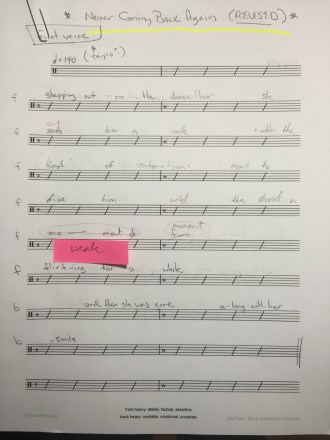
Pat Pattison’s songwriting method offers an interesting way to apply the concept of stability/instability when we set words to music.  He refers to this as the ‘body language’ of a song and, rightly, points out that most of our communication is non-verbal in nature.  In other words, how we say or sing something is probably more important than the actual words we are saying or singing.

Pattison uses the terms ‘front heavy’ and ‘back heavy’ when he talks about stability/instability with the setting of lyrics to music with this fundamental distinction:

  • Front heavy phrasing is stable
  • Back heavy phrasing is unstable

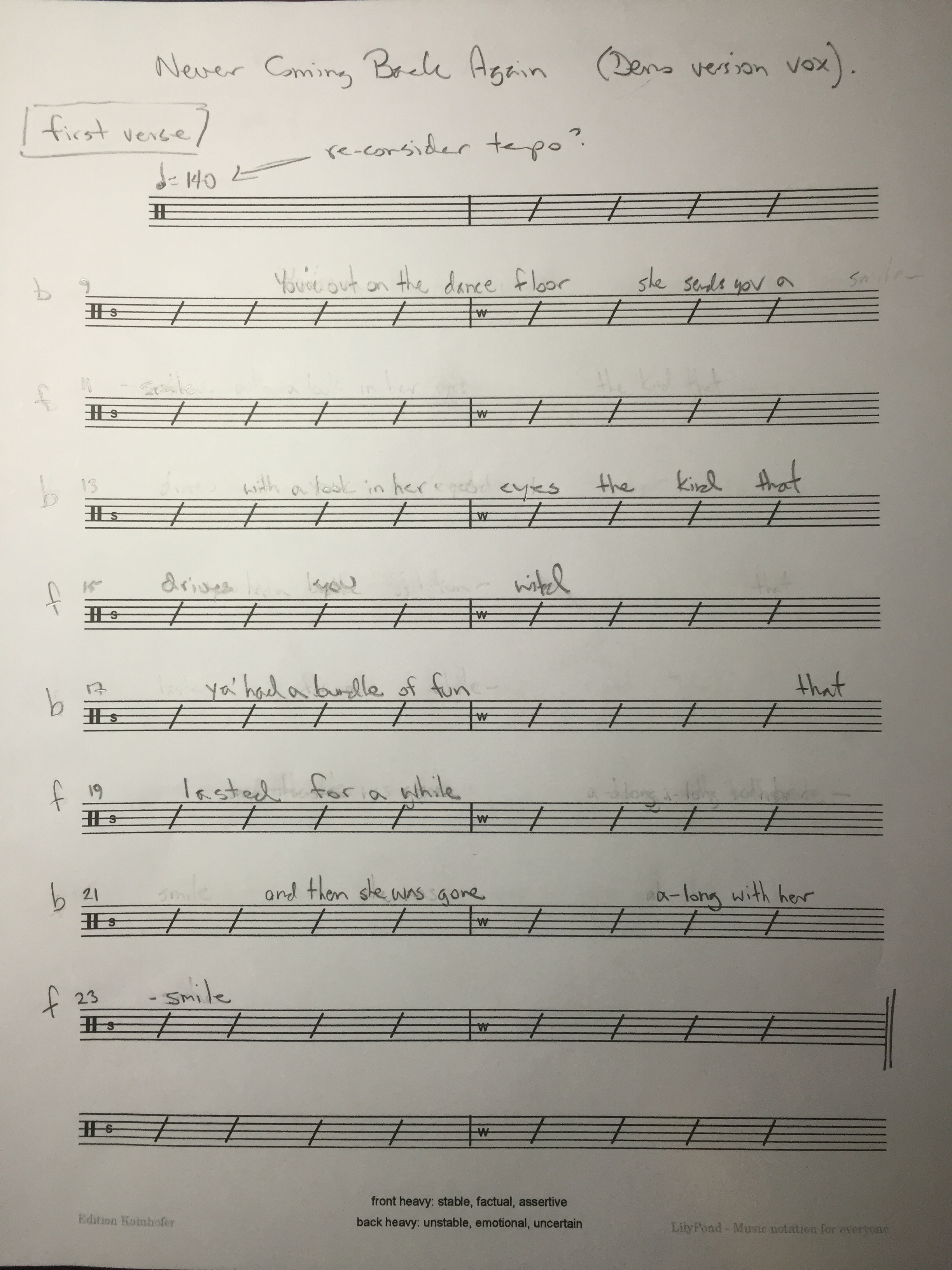
So what does he mean?  Front heavy phrasing emphasizes key words on strong beats.  In 4/4 time, that means the first and third beats of a measure.  Back heavy phrasing places key words on weak beats.  In 4/4 time, that means the second and fourth beats.  In practice when we sing, the placement might not be exactly on a beat but the idea here is a rough guideline.

Front heavy phrasing is called for when we want to convey a sense of being assertive, confident, factual.  Back heavy phrasing is called for when we want to convey a sense of uncertainty, loss, trepidation.  Used in combination, the two techniques can be subtle but powerful when aligning the body language of you song with with the content of the lyric.  Pattison’s demonstration of it in action (see link above) is quite revealing.

I’ve applied it to my own writing and I am becoming convinced that there is definitely something to this approach that improves my songs.  Not only that but it gives me a helpful tool for analyzing my lyric setting especially when something just doesn’t sound right to my ears.  By examining the placement of my lyrics in relation to front/back heavy emphasis, I find I can make more informed decisions when I want to make changes to the song.

In the next post I’ll share a worksheet technique that I’ve developed for analyzing the body language of my songs.

Working the Body Language of a Song (Part 1)

Pat Pattison is a professor at the Berklee College of Music and a widely respected songwriting coach and mentor.  I’ve written about his approach to songwriting before and find it a helpful way to approach the process most especially during the revising and polishing stage of writing.

If I were to identify two key ideas that inform his approach to writing better songs they would be these:

  1. prosody
  2. stability/instability

I’ll talk more about Pattison’s notion of prosody in a future post but for now I want to focus on his second idea of stability/instability.  The idea is closely related to the notion or consonance/dissonance in music (or tension/release in other forms of writing).  Depending on the intended emotional effect of a piece of music, as writers we want to be aware at all times whether the idea or expression has the quality of assertiveness (stable) or uncertainty (unstable). 

More importantly, we want to be able to use techniques that help our writing to convey these qualities in effective combinations.  In other words, we want to design both stable and unstable elements into our songwriting.

The simple I-IV-V formula for blues progressions is an example of these two elements in a time-honored combination.  It begins with the tonic (I) chord, moves to the subdominant (IV) chord creating a sense of movement (slightly unstable), then back to the dominant (stable), then to the subdominant briefly before heading to the dominant (V) chord (unstable).  With the dominant (V) chord, instability/tension is at its maximum and it resolves satisfyingly back to the stable tonic (I) chord.  It’s like a journey that takes us away and brings us back home.

Many songwriters already understand this aspect of music composition but some like me hadn’t thought about applying it when we set words to music.  And that’s where Pat Pattison’s notion of ‘body language’ in lyrical phrasing comes into play.

More about that in the next posting.

More on simplicity and songwriting

The Glenn Morrison/Islove song “Goodbye” is a current example of success through simplicity.  It contains a strong melodic hook with a compelling visual image as the centrepiece: “…and it starts to snow in the streets of Mexico.”

It’s one of those lines that I can imagine a songwriter just blurting out as they play through the chord progression and then realizing they are on to something interesting.  The winning element here is that Morrison didn’t bury that line in complexity but chose to showcase it with a catchy and infinitely repeatable melody.

The song itself is a common chord progression (Am/F/G/Am) with only the addition of the C (Am/F/C/G) to create contrast between the opening verse and the lead up into the chorus.

From a production standpoint, however, there is quite a bit going in this song.  I suppose that’s the caveat to Gary Ewer’s comments about simplicity and success.  Dressing a song up for contemporary hit radio is perhaps the producer’s art form.  The right tempo, the right drum track, the sound textures (including Morrison’s use of a sample from “Every Breath You Take”), the perfect vocal performance, etc.

Simplicity is one thing.  Making the most of the song for the intended audience, especially contemporary hit radio, can be a very complicated and delicate undertaking indeed.

Capital City Records in Edmonton

This is a great initiative to support local talent in Edmonton.  The Edmonton Public Library has launched a program called Capital City Records to establish a public digital space to celebrate the local music scene and its history.

Anyone can stream the albums but if you have an EPL library card you can also download the tracks.

They plan to add 100 albums per year, with the call for the next round of submissions coming up this Fall.

Good Man Down (Take 2)

I’ve taken a break from SAC Challenge 2015 this week because of other commitments but today I took a shot at revising how the lyrics are set to “Good Man Down.”

Over the past few weeks I’ve also been taking Pat Pattison’s course on songwriting.  Among other things, he talks about “body language” and setting lyrics front-heavy or back-heavy.  Front-heavy is on the first beat of the bar, back-heavy is set back in the bar.  Pattison says that front-heavy lends itself to “stability” and back-heavy to “unstable”.

Following the general principle of prosody in songwriting, his approach is to think about and apply front/back heavy to lyric setting as a way to reinforce key ideas and themes in a unified way.  There’s more to it than I can describe here but it is a helpful set of guidelines.

This morning I re-recorded Good Man Down with a vocal performance that sets the lyrics quite a bit different from the original recording.  The verses are now more front-heavy, with selective back-heavy lines in various spots to give emphasis where it is needed.  It’s subtle but it makes a difference (at least I think so).

Here’s GMD, take 2:

The original recording of the song is available here.

SAC Challenge 2015: Week 4 “Good Man Down”

The challenge this week came from Ron Irving who asked us to write an “edgy” country pop tune with some added criteria:

Male artist, early 20s, no mention of marriage or kids, no references to partying at the lake, and no “bro country” vibe (I’m not sure what that means).

I don’t listen to much country per se, so I spent a few days getting exposed.  Wow, the genre is really wide and there is plenty of room for crossover with pop/rock.   What makes it country?  The accent.  The content.  And, interestingly, almost every song I heard was written in first person POV.

So here it is.  It does include mention of (a) beer ; (b) a woman; (c) a truck;  And the guy loses his woman and his job.  But if you stay with it, there’s a moment redemption at the bridge and third verse of the song.


Enjoy!

Good Man Down

Friday night he gets home late
grabs a beer and sits and waits-
for that woman he loves so much
what would he do without her touch

He finds a note by the kitchen sink-
she wrote it fast, in lipstick pink
she’s going south to West Palm Beach-
for sun and sand, and another man
God, he’ll never understand

Why an honest guy can’t get a break
he keeps on losing ground
when a lover leaves him in misery
we got another good man down

Monday morning he shows up at work
grabs his tools from out of his truck
he does this job to pay the rent
but by the end of the week the money’s spent

The boss is shoutin’, callin’ his name
tells him business just ain’t the same
they’re closing down the shop today
the payout’s just a couple of grand
we hope that you’ll understand

That an honest Joe can’t get a break
he’ll keep on losing ground
and when the economy leaves him in misery-
we got another good man down

Oh, he could crawl into a hole and hide
or he could curl up and die
but something stirs in him deep down inside
and he gets back up on his feet again

This stretch of highway is all his own
he puts the pedal down and leaves his home
it’s time to make a change for good
he’s gonna get what he needs
to hell with what they might believe

An honest soul can get a break
he might even gain some ground
he’s had enough of dealing in misery
you can’t keep a good man down

We got a good man down
we got a good man down

SAC Challenge Week 3: “Wear Anything”

This week’s challenge was tough but I came up with a song early in the week.  I spent a day touching up the lyrics and recording a simple, quick demo of “Wear Anything”.

Kids love hats (so do grown ups) and idea is fairly obvious.  You can grow up to be who you want to be.  I will love you for who you are.

I’ve included two links to the demo.  The first is my original recording, the second features another SAC Challenge participant Mikalyn Hay.  I think the song is suited to a female vocal and she kindly agreed to sing a version of it for me.  Thanks Mikalyn and Michael!

Wear Anything

Who you gonna be-
Where you gonna go-
What kind of hat are you gonna wear?

A baseball cap-
A cowboy hat-
A pink beret or a derby

A panama-
A yamaka-
A black pork pie or a beanie

You can wear anything-
with that smile on your face

A tam o’shanter-
Just might be you-
Maybe a turban or a fez

A fruity hat-
Or a propeller cap-
Something crazy to make the news

You can wear anything-
with that smile on your face
You can wear what you want-
for me

Here’s the original demo.


Here’s the version in a different key featuring Mikalyn Hay.


SAC Challenge Week 3: Writing for Advertising

This week’s challenge comes from Heather Gardner, Music Supervisor for Vapour Music.  She wants us to write a 60 second spot that “captures the spirit of a child.”  She cautions us that it shouldn’t be emotional or “heart-stringy” but instead fun and quirky.  “Purely fun” is the exact phrase.  The lyrics need to speak to childhood (in a fun way).

A number of reference tracks are provided, including The White Stripes “We Are Gonna Be Friends“, “Mushaboom” by Feist, and Karen O’s “Where the Wild Things Are.”

We’ll also need to be able to slice the song into 15/30/60 second cutdowns.

This is a good challenge and I think I get the gist of it, having listened to the reference tracks.  My first impulse is to go minimalist, with a Jack Johnson vibe.  I have a riff and a few lyrics for a song about “hats”.  Yep, headgear.  Let’s see what happens.

SAC Challenge 2015: “Choose” now at demo stage!

I’ve been writing about the progress of my song “Choose” for the 2015 SAC Challenge.  Rob Wells has challenged us to write a pop song for a female vocalist and aimed at the teen market.  Oh, and keep it under 3:30.

This is outside my comfort zone but I’ve managed to cobble something together.  Thematically the lyrics centre on the idea of having “choices” and the girl wanting the boy to commit to choosing her.

I’m singing on the demo but clearly it would be better to have a female vocalist doing it (if anyone is interested I can provide the music bed).

The melody could be a bit stronger in my opinion but I’m happy with the overall results, especially given that at the beginning of the week I wasn’t sure if I was going to have anything at all to share.

It’s a simple chord progression all the way through (D/G/B/A) and relies on changes in the lyric phrasing to give it a sense of movement.  The song doesn’t have a bridge per se, although I stuck in a short break before returning to the chorus.

Apple loops are used for the rhythm tracks but I played the other synth parts that embellish it.  I also snuck a little bit of distorted guitar in the final section to give it some grit.

Here are the revised lyrics as sung on the demo.  A link to the song is below the lyrics.

Choose

When it comes to music-
you have to make a choice
do you like it straight or swing-
do you want to dance or sing

When it comes to movies-
you’ve got to make a choice
do you want to laugh or cry-
or do you like a thrill ride

When it comes to a lover’s test-
it’s multiple choice
it’s your voice
so what’s it gonna be boy-
A, B, C, or D

I know love is strong-
but if you wait too long
I’ll be gone before you know it

So you can make your move-
you know I will approve
and I’ll love you over and over again

Let’s not wait forever-
to be together
you don’t want to lose me-
it’s time to choose

When it comes to candy-
you have to make a choice
do you like it sticky sweet-
do you like to trick or treat

When it comes to fashion-
you’ve got to make a choice
do you go for Calvin Klein-
or any old design

When it comes to a lover’s test ….

[repeat chorus]

SAC Challenge: finding a unifying theme for the song

In my last post I shared the chorus for a song called “Choose.”  One thing I admire about the pop formula is how songwriters will establish a unified theme around a simple concept and play with it in the verse development.

Echosmith’s “Bright” is a love song that uses astronomical imagery as a unifying theme:

Did you see that shooting star tonight?
Were you dazzled by the same constellation?
Did you and Jupiter conspire to get me?
I think you and the Moon and Neptune got it right
‘Cause now I’m shining bright, so bright
Bright, so bright
Bright, so bright
And I get lost in your eyes tonight

This kind of writing takes a simple, everyday word or cliche and puts a new spin on it.  I love the ingenuity in it.

So, for “Choose” I’m working on the idea of choice as a thematic motif.  I’ve started to develop some verse ideas. I’ll share them in my next post.