Two Nights in Toledo

One aspect of songwriting that I enjoy the most is the element of surprise. There is a thrill that comes from not quite knowing where an idea might go as it develops from a song seed into a finished result. It’s a bit like a write-your-own-adventure story without the ability to skip to the ending!

One of my approaches to writing lyrics is to simply to play guitar and let words come out of my mouth. I record multiple takes and listen. It’s a bit like stream of consciousness writing because during these sessions I’ll just sing stuff. Much of it is nonsense but every now and then an interesting expression comes out and becomes the basis for a lyric.

Yet, and more often than not, I’ll sing or mumble something that makes me think of something totally unrelated. I now realize that this is less like stream of consciousness and more like one of those inkblot tests where the blob lifts an idea or image from out of the realms of the subconscious.

Songwriting, as many have noted, is only 20% inspiration. The 80% perspiration part comes from thinking and listening, trying and testing ideas over and over until something clicks. “Two Nights in Toledo” is one of those songs. It began as a passing thought while I was packing for a business trip to that city a couple months ago.  It seemed like an interesting sounding word combination so I wrote it down.

Then one evening I started singing the phrase while playing a guitar riff similar to “Sweet Home Alabama.”  Some mumbled lyrics during this take that I recorded yielded interesting results later on:

“Two nights in Toledo/could change a lucky man” later became “Two nights in Toledo/could make you a different man”.

The other phrases I sang didn’t actually say very much but they prompted some ideas based on the way they sounded and turned into “A good day in Las Vegas” and “Three Days in the Dakotas” and “Two weeks in Missoula”.

But what about two nights in Toledo? How could that make you a different man?

I had one idea–that travelling to small towns can lead to big changes.  Not bad, but it needed more to it.

So here’s the perspiration part, I guess.  I did research on Toledo (Ohio, not Spain) looking on Wikipedia for something interesting I could tie it to.  Here’s what I found aside from it being Maxwell Klinger’s home town in the series MASH and the namesake of the exclamation “Holy Toledo!”:

  • John Denver denigrated the city with the song “Saturday Night in Toledo” performed in 1967 on the Tonight Show, leading to a large public outcry at the time;  Oops.
  • the prog rock band Yes mentions the city in “Our Song” from the 1983 album 90125;
  • the city has hosted a baseball team dating back to 1896 called the Toledo Mudhens;
  • the Maumee River runs through the city, connecting it to Lake Erie;
  • and the inspiration for the 1970s song “Lucille” (sang of course by Kenny Rogers) is associated with the city;

And that’s where it got interesting.  Out of curiousity, I looked up the source to that last bit of trivia and discovered it mentioned in a March 22, 2010 story from the Toledo Blade newspaper about the recent closure of Caesar’s Show Bar, a historic location with a notable reputation as “the stiletto-heeled stomping grounds of local drag queen legends.”

The story says that although “it wasn’t the first drag bar in Toledo nor the only place with female impersonators, it was the best known and had the longest run, strutting through three decades of diva acts.”

Moreover, the story goes on to report that prior to its run as a drag bar, the location had previously been called the Country Palace bar and was where songwriter Hal Byman stopped in for a drink in the summer of 1975:

Mr. Bynum wandered across the street from the current Greyhound station at Michigan Street and Jefferson Avenue. Thirsty for beer, he stepped into the Country Palace bar that was then in the building.

As he sat at a corner table, Mr. Bynum said, he heard a conversation between a man and his estranged wife. There was an angry exchange, and the man got up and told the woman, “All I can say is, you picked a fine time to leave me.”

A song idea hit him, and Mr. Bynum grabbed a napkin and started scribbling words. With later help from Roger Bowling, the idea evolved into the 1977 chart-topping Kenny Rogers country song “Lucille.”

“In a bar in Toledo/ across from the depot/ on a bar stool, she took off her ring,” the lyrics begin.

Although I personally have no substantial connection to drag queens or divas, or Kenny Rogers for that matter, the Blade story did suggest to me how two nights in Toledo could make you a different man.  From there I’ll leave the rest up to the listener.

The point is this: that bit of informal research took the song into a direction that I could never have anticipated.  The original inspiration from a passing thought combined with some mumbled words sung during a writing session, came to fruition with patience and persistence, and a bit of perspiration.  The reward was a journey into a theme and set of lyrics that I had no idea was coming.  And yet it did.  This is for all you Toledoans.

The image “Eye on the prize” is by darwin Bell courtesy of Flickr Creative Commons.

Carry On

A few months back I wrote about using Flickr as a source of visual inspiration for songwriting. At the time, I was working with a line “She’s like a merry-go-round” and had some vague ideas about how the song might develop.  I continued with that initial theme of amusement park as a place to experience young love.

The final result is called “Carry On”.  I wrote about the title and the bridge to this song in another earlier post.  The original version was written for acoustic guitar with a much slower tempo in mind.  When working on the demo, I brought the tempo up to 124 bpm and added a more complex arrangement, including some vintage analog synth parts that seemed to complement the mood of the song.  Trumpeting the love, as it were.

The image is from a colour linocut by Cyril E. Power, called “The Merry-Go-Round” and posted on Flickr Creative Commons.

Meet me in Montreal

It’s interesting to see how an idea changes from one form into something completely different as it evolves in the writing process.  In this case, the song began with a guitar pattern that derived from another song called ‘February.’  I’d been listening to Iron and Wine quite a bit around this time and found myself mimicking the playing style of the beautifully subtle songs from the album Naked as We Came.

I was drawn to the mood of this pattern and spent a week or more trying to fit it to a lyric.  Somewhere along the line I hit upon an idea and dropped the pattern entirely, opting instead for a very simple chord progression using the G/C/Em forms.  I tend to play with a capo on the 2nd or 3rd frets, so the tuning in the recording will be a full tone up, which seems to suit my vocal range.

The lyric itself is inspired by a personal experience with a good friend who never made it to the end of his journey.  I had the good fortune to play it live with another friend at a recent reunion, where we performed it as a personal tribute.

“WTF”

Whiskey, Tango, Foxtrot as my colleague likes to say.  Yes, it is an expression of amazement or dismay.  But it also could stand for “Write To Finish.”

Macro of music sheet of a classical piece

I’ve adopted an approach to my songwriting based on this mantra.  Write to finish, I repeat to myself whenever I get bogged down with a lyric or musical part.  Write to finish.

The idea is simple: don’t get hung up on making it perfect.  Aim for a beginning, middle, and end.  Push through that sense that it has to be perfect and just get it done.  Use placeholders if necessary to keep the process going but aim to finish it.

“Finished” doesn’t of course mean polished.  Polishing comes later.  Some songs may become reservoirs of ideas for other songs.  Other times I might cannabalize a song to use in another song.  It doesn’t matter.  Writing to finish is an important mantra for me because it helps me to relax about the little things and gives me a sense of freedom that lets me push through the process and give the idea full form and expression.  Finesse can come later with three following stages: revise, rehearse, record.

Lyrics: show, then tell, then reflect

James Linderman, writing in the 2011/2012 issue of Songwriters Magazine, offers a helpful guideline for thinking about song structure:

  • verse lyrics show
  • chorus lyrics tell
  • bridge lyrics philosophize

It’s a helpful insight that can focus and hone the writing process.  The idea of showing something can involve all of the senses, so it need not be limited to visual images.  For example, evoking a sense of touch is powerful (“your breath in my ear”) and has an emotional draw that strictly visual elements might not convey as well.  Scent and sound of course are other important dimensions of our experience.  I’ve been working on a song that uses imagery from an amusement park to establish a context and mood for a story about two young lovers.  Some of that imagery was inspired by images I found on Flickr and posted previously.

The chorus is where the hook is typically found in a song, so summing up the key idea of the song is part of the “telling”.  The chorus can also be a place where word play is engaged and double-entendres can be employed to good effect.  In the amusement park song I stumbled on the phrase “carry on” as the hook for the chorus.  Because the song is about young lovers, the phrase works nicely in a dual sense.  It can mean rambunctious behaviour on the one hand and/or the idea of keeping it going on the other hand.  The lovers in the story are both having a blast at the amusement park (“carrying on”) and they both want their love to carry on forever.

Bridge lyrics can act as a pivot point and provide a moment of reflection in the song.  In “Carry On”, the bridge isn’t yet written but I want it to touch on the idea that the main character knows deep down that this moment of joy will pass and so he wants to take full advantage of it while he can.  With that, the bridge will also require a shift in mood that can be linked back to the chorus, returning to the celebration after the pause for reflection.

If the amusement park is imagined as part of a travelling carnival, then I might be able to draw on the idea of the empty lot that remains after the tents and rides are taken down and on their way to another city.

While we are in the midway and the swept up in the lights and sounds it seems like it can last forever.  But the next day we wake up to find an empty parking lot.  The spirit of the moment has moved on.

Now I just need to find the right words to express that sentiment.

“Country Girls” to the rescue!

I’ve started to experiment with a TC Helicon VoiceLive Play GTX vocal processor.  It’s a great little unit that gives me the opportunity to add harmonies and other effects to songs as I’m developing them.

I’ve had a blast with it so far and am impressed with how quiet it is when going direct to my DAW.  One of the first songs I tested was my own “That’s What You Do”.  This has a country feel to it and I sensed it needed some talented backup vocals to bring out the melody.

Voila, “The Country Girls” (preset number 212) to the rescue!  Here’s an excerpt from a working demo.  This was recorded with my vocals and acoustic run straight as a stereo pair out of the VoiceLive Play into my Focusrite preamp, then captured using the StudioOne DAW.  Not bad for a quick setup to test ideas and arrangements.

Resurrecting an old guitar

The first electric guitar I ever owned was a Japanese-made Vantage VS695 ‘Vamp’, bought from a friend for $150 in the mid-1980s.  It has been a great companion over the years, from high school rock bands and into my early twenties when I moved to Vancouver and began using it in the studio during my time in Vancouver as a student at the Trebas Institute of Recording Arts.  (Trebas no longer has a Vancouver location).

My favourite studio setup with it was through a small Marshall amp using a Boss Compression pedal to give it a bit of boost.  I recorded a number of early demos with it.  The missing pickup and toggle switch was a result of my own half-baked attempt at modding the guitar in my late teens, while the duct tape is compensating for damage done when my bass player stepped on the cable during a show.  That tape is probably over 25 years old!

In any case, it still sounds good after all these years, so I took it to a friend here in Edmonton who loves to work on guitars.  He’s done some great work for me setting up my other instruments and I presented this to him as a summer project.

ImageThe ‘Vamp’ in poor condition after a couple decades of use and abuse.  Missing pickup, missing toggle switch, damaged body around the input jack.

IMG_0412On the workbench in Kurt’s shop.  Neck removed and electronics exposed.

ImageInitial patch job on the input jack from the inside.
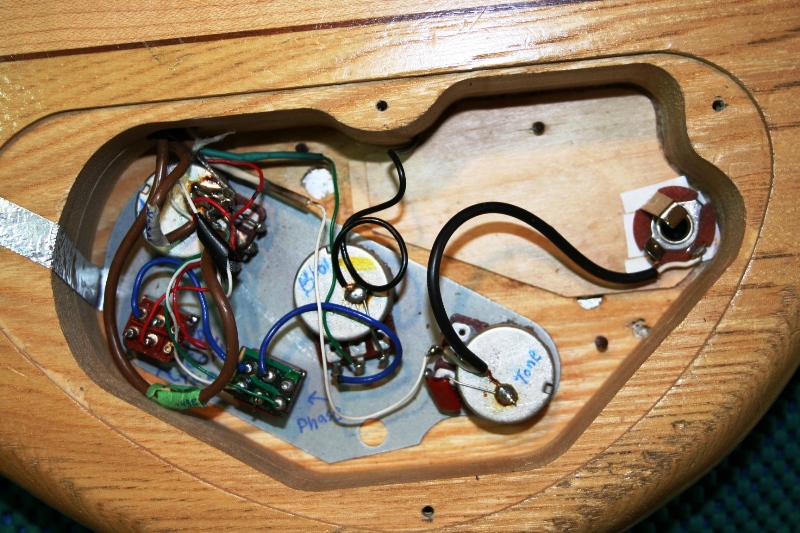
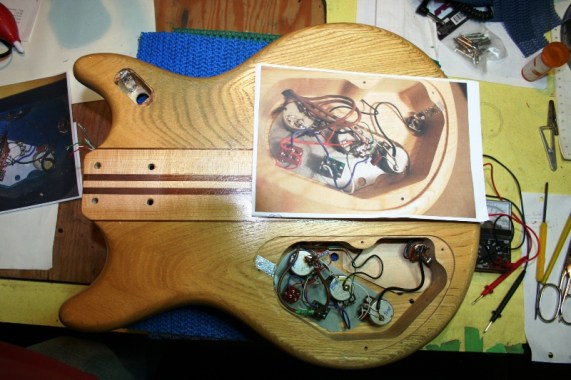
ImageTwo thin sheets of veneer inside to reinforce the input jack.  Kurt has labelled the pots in preparation for reinstalling the pickup and the toggle switch.

ImageKurt found someone online with the same guitar, who had posted photos of the original wiring setup.  It’s amazing what that Internet will come up with!
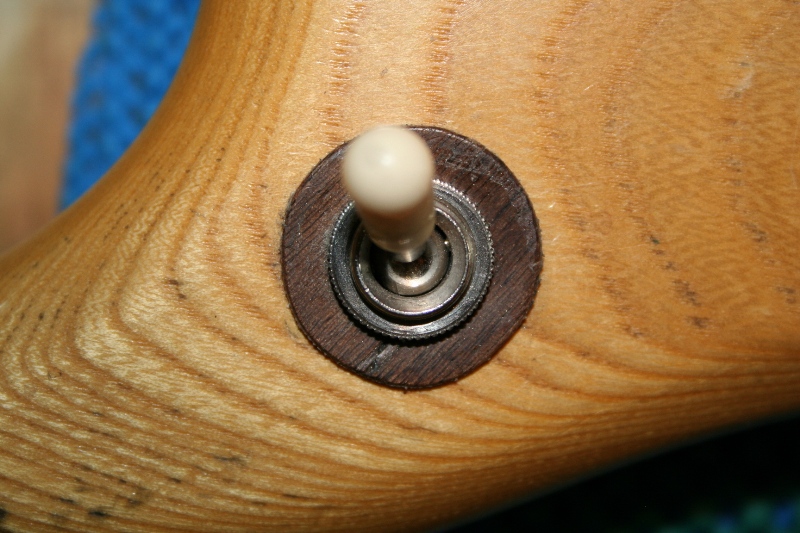
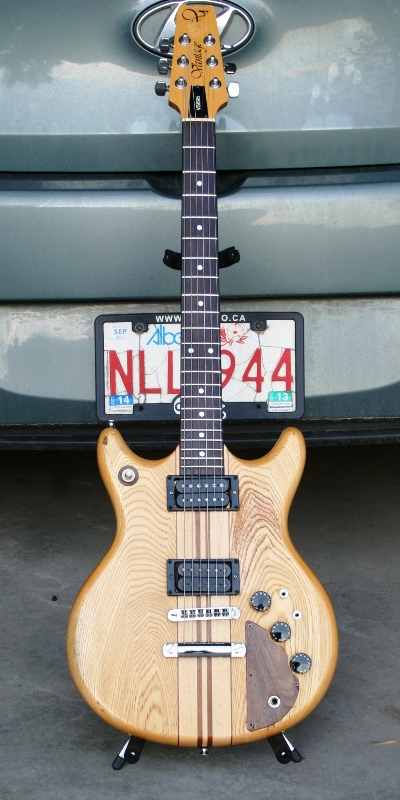
ImageSwitches and pots labelled.  Toggle switch.  Second pickup reinstalled (I had kept it in the guitar case all these years after removing it.

ImageClose up of the labelling.  The VS695 has a coil tap and phase switches, giving it quite a bit of flexibility in tone.  For years, I have to confess had no idea what those switches were there for.  Thanks Kurt!

ImageA think sheet of maple veneer to cover the damage on the input jack and provide some strength.  Kurt chose the colour to match the pin striping on the guitar.

ImageClose up of the reinforced input jack.  Kurt made the extra effort to notch out the plate around the pots to give it a slightly more elegant look.

ImageA small ring added to the toggle switch to complement the new plate.  A nice touch.

Image

And a practically new Vantage VS695 and the Vamp sounds as good as ever.  Thank you Kurt for resurrecting this special instrument for me!

Using Flickr for lyrical inspiration

I’ve started to use Flickr to browse images that are related to an phrase or theme that I’m working with in a song sketch.  It’s an interesting exercise that helps to generate fresh ideas that also have a visual dimension to them.

For example, I’ve been working on a song with the phrase “she’s like a merry-go-round”.  That line came out spontaneously while I was noodling but it seems like an interesting element to build a theme around, so I went to Flickr and browsed the images that came up when I searched that term.

Images like the one below got me thinking about lovers sitting together, moving up and down as the merry-go-round turns. Sometimes they move in unison and sometimes in counterpoint.  This suggested to me the up and down cycles of relationships.  There is also an energy in this photograph with the horses, their mouths open, that evokes a sense of raw passion that might be seen in two young lovers.  Lots of fodder for lyrics here.

Merry Go Round

Or this one here, which for some reason reminded me of a music box and that sense of childhood often associated with amusement parks.  I later wrote a wraparound line “I want this to last forever” to tie two verses together.  It might very well have been a subconscious response to seeing this image:

Merry Go Round

This one is a long shot of a pier with an amusement park, and brings thoughts of the seaside and a stroll in the evening air.  I might never have considered either of those thoughts had I not seen this picture.

merry go round

The various elements within the images provide a rich field of ideas that I might not otherwise have immediately associated with a “merry-go-round.”  But that richness, that unexpected diversity, leads to more intricately developed themes and more interesting possibilities for lyrics to take shape.

Another dimension to this approach is to see how other people choose to photograph a merry-go-round.  This helps me to understand the kinds of images that this phrase might evoke in listeners and provides some clues about what to emphasize or draw out in the lyrics.  For example, I saw many time-lapse images of merry-go-rounds, which suggests that it might be something that people will relate to in a song.  I’m not sure what that might look like in a lyric but the seed has been planted.

 Merry-go-round

I don’t print the pictures, but I do set up links to the ones I find most interesting and refer to them while I’m working on the song.  I suppose one could print them and put them up in the studio for inspiration as well.

Whatever the case, Flickr and other photo sharing sites seem to me to be a great resource for opening up the imagination during the writing process.  Thank you Internet!

Bumpercars!

Being a Mac user I had been tinkering with Garageband for a number of years before using it as a writing platform.  In early summer 2009, I used some of the canned content on Garageband to create a few fun songs for my young son to listen to while I was going to be away travelling on business.

One of these songs was inspired by an improvisation we did one day in the living room, riffing on the phrase “bumper cars”. This was then combined with a few personal references related to some casual trainspotting we used to do (“here we go down to shunty yard”) as well as thematic elements taken from the Pixar animated film Cars, which he was very much into at the time.  The music is an unaltered Garageband track but the words and vocals are mine.

Probably like a lot of other folks out there, Garageband has played an important role in (re)kindling my desire to create music.


On returning to songwriting

I began songwriting in my late teens.  At some point in my mid-twenties I stopped and went on to other pursuits.  Now at mid-life I’ve taken a new interest in putting words to music.  It’s mostly for my own pleasure, but part of that pleasure comes from sharing it with others.

So this is a place where I can reflect on the creative process, on what it means to be doing this kind of thing as a forty-something father and husband, and where I can share the fruits of my labour of love with a few friends and family members, or perhaps beyond.