Introducing the Sunophonic Sessions

I’m excited (and, truthfully, a little nervous) to share a new chapter in the Selkirk Range project: The Sunophonic Sessions.

This collection of songs is built around something I hold sacred—words. Every lyric in this forthcoming collection of songs is my own, written by hand over many months and years. That part of the music—the storytelling, the voice behind the voice—is something I feel strongly about preserving. These are my stories, my images, my turns of phrase.

What’s new is how they’ve been brought to life in musical form.

The arrangements and performances you’ll hear weren’t created in a traditional studio. They were rendered using Suno.ai, a generative music platform that transforms lyrical and stylistic prompts into fully realized musical performances. At first, I was unsure—skeptical, even. I wondered whether it could really feel anything like music made with people in a room.

But what surprised me was just how responsive it is. Suno can infer mood, phrasing, and even expression in ways I didn’t expect. The platform—still early in its evolution—has a remarkable knack for giving voice and shape to a song. Quite frankly, it’s been a thrill to hear these words set to music like this.

Over the past decade, I’d written some two dozen songs that have been sitting in a collection of notebooks and pre-production demo recordings. As I began shaping them with Suno, they seemed to naturally split into two distinct sounds: one leaning into country traditions, the other into more adult-oriented folk-pop. The result is the Sunophonic Sessions, which will be released across a single and two albums:

  • The Ballad of the Titan is available on Bandcamp now and will be released on the other streaming platforms soon. It’s a slightly quirky take on the ill-fated OceanGate submersible, playing on the connection between the words Titan, Titanic, and Atlantic. You can read more about it in my earlier post.
  • Hired Gun, arriving on August 22 has something of a classic country feel, pairing plainspoken storytelling with easygoing melodies. I brought in Colin Noel from Electric Treehouse studio to add final polish to the mixes and mastering of this collection.
  • Duty. Courage. Truth. will follow later this year, exploring an adult contemporary sound with folk-rock at its core. Textured arrangements and reflective themes move across a range of moods, from intimate to anthemic. You can hear a pre-release version now on Bandcamp — and while you’re there, follow Selkirk Range to get updates and be the first to know when the album drops.

Above all, the greatest reward for a songwriter is finding an audience who feels the words and emotions you’ve poured into a song. In that sense, how the music was produced matters far less than whether it connects. Hearing these songs come back polished and expressive has been like hearing them for the first time — a mind-blowing experience for a songwriter working with limited resources. The tools may have changed, yet the intent remains the same: to create songs that are meaningful, and to offer them with the hope they’ll find a home in someone’s heart.

Thanks for listening.

– Gordon (Selkirk Range)


Look out for the first releases from Hired Gun and Duty Courage Truth coming soon.

SAC 2016 4X4 Challenge update

I am delighted to announce that one of my songs for the SAC 2016 songwriting challenge made the special mention list.

The challenge was coordinated through a closed Facebook group with 82 members, many of whom submitted songs for consideration each week.  Moderators listened and commented on all of the submissions, while the challenger was asked to picked a few of the songs for special mention.

The goal for Week 2 was issued by Northern Pikes member Bryan Potvin who challenged us to write a song that tells a story.  My song “Can’t Take it Back” was one of three chosen by Bryan, who wrote

Selkirk Range’s “Can’t Take It Back” is killer country music. Country has always been a genre that relies on ‘the story’.  This tune totally delivers, complete with a gorgeous melody and heartfelt performance.

Thank you for this Bryan.  It means a lot to get positive feedback on something that has consumed much time and energy (not to mention patience) to create.  And a special thank you to Rosanne Baker Thornley and North Easton for the tremendous–and I mean tremendous–effort they both put into the Challenge as moderators and mentors.

The song was written too late for the upcoming release, but maybe this is the motivation I need to consider doing a follow up single for next year.


SAC 2016 SONGWRITING CHALLENGE WEEK 4

I’m late submitting this week but I met the challenge.  This week we were asked by Toronto-based singer-songwriter Emma-Lee to “tie two tunes together” by marrying parts from different unfinished songs into a new composition.

This was a hard challenge in part because I have many unfinished ideas but trying to bring them together in a new arrangement is surprisingly difficult.  Different rhythms, different keys, different moods, etc.  After sifting through my iPhone scratch recordings for some time, I finally decided to merge a melody from one fragment of an idea with a guitar riff from another.

The chorus was part of the guitar riff idea and the melody came from a very different song idea so I essentially had to write the lyrics from scratch.  The chorus is suggestive of a theme but I had to work out an angle on it.  In this case the lyrics aren’t too specific but lend themselves to a relationship-type song.  I decided I also wanted to keep it simple and short, so I opted for two verses with a short bridge, bringing the whole thing in under 3 minutes.

It’s a bit more pop than what I’ve been writing lately and the production is more than I would usually do for this kind of demo but I had fun with it, and that’s what matters

We’ve Both Been There

I know that love can be confusing-
when it undermines those plans you made
But I also know it bears repeating-
you’ve got two choices when you’re scared

We’ve both been there

I know frustration likes to hang around-
ticking like a time bomb that you wear
Before it blows you need to recognize-
there are others out there who still care

We’ve both been there

And I won’t tell you no lies-
cause I can see in those eyes
we’ve both been there

We’ve both been there

Words and music by Gordon Gow, Copyright 2016
Featured Image by Holly Jay flic.kr/p/sjJRJA


Preproduction session 4: the sound of silence

This session we continued to run songs, discussing structure and arrangement.  One of the important considerations as we begin to imagine the songs in production is the balance between sound and silence.

Context, as they say, is everything, and learning how to use silence to frame a melody and lyric can really bring out the most in a song.  One proverb I came across sums it up well: words are silver but silence is golden.  We frame the words with silence.  Silence makes it sing.

FullSizeRender

Everett and I running songs in his studio

In any case, working in the modern digital studio with hundreds of gorgeous sounds at your fingertips makes it very tempting to fill up the silence with a rich but unnecessary arrangement.

We know this and so we’ve been talking about how to strike a balance in the songs that will give them an interesting sonic texture that brings out the most of the melody and the lyrics.  A golden frame for silver words, as it were.  When does the lap steel come in?  At the beginning or in the second verse?  Does it play throughout, or only at one or two points in the song?  Should we have backup vocals in this part?  What about a tone wheel organ?  Or nothing.  Just a single note the guitar maybe.  So many possibilities.

From a production standpoint, one approach may be to try out lots of different ideas and explore options before making decisions and stripping it to the essentials.  But this still comes down to a subjective decision in the process, and one where experience and a sense of discipline will pay off in the end.


Working the Body Language of a Song (Part 3)

This is the third in a series of postings about the body language of a song.  I first heard that term from songwriting consultant Pat Pattison, who uses it in reference to lyric setting.  In my previous post I described Pattison’s concepts of front and back heavy lines in relation to creating stability or instability in a song.

A key lesson in all this is to ensure that the lyrics are set against the music in a way that delivers maximum intended impact.  As Pattison correctly observes, what we say is often less important than how we way it.  Setting a lyric to music is about how we deliver the words.

I’ve started to use a worksheet method to help me analyze my own writing and, hopefully, to improve the setting of my lyrics by paying attention to front and back heavy emphasis.

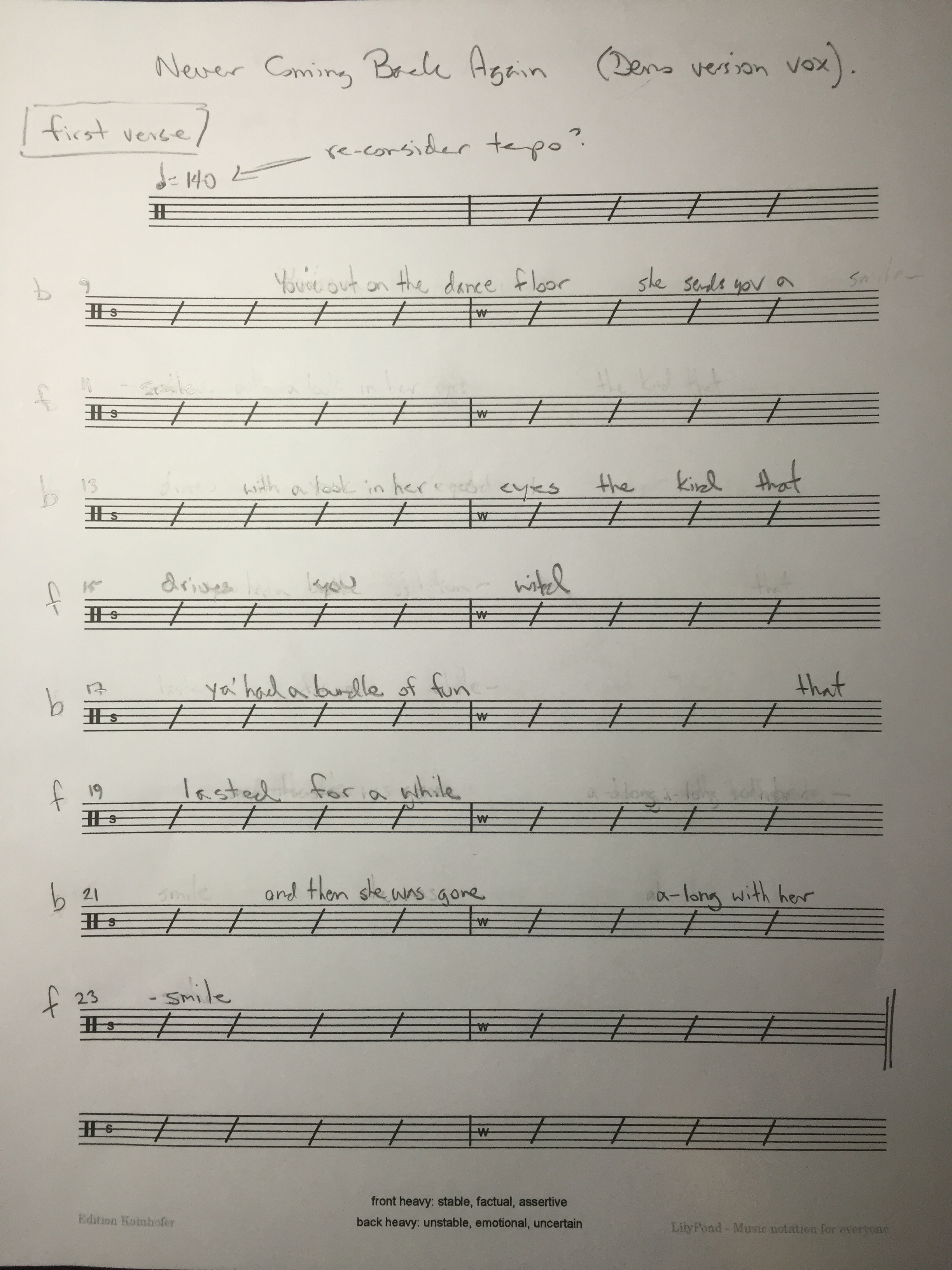
IMG_0348 IMG_0346 

The worksheets use a single stave drum clef divided into 2 measure per row, each with slashes representing each downbeat in the bar.  When working with my DAW, I also note the measure number of the lines to help me locate it on the recording.   After I’ve recorded a performance of the song I go back and analyze it, transcribing the lyrics using the worksheet.

In the example above, the version on the left is the lyric as originally set in the demo recording.  I wasn’t happy with it and felt that it wasn’t well set with the music.  When I transcribed it using the worksheet I realized that the phrasing was predominantly back heavy (in the margin I wrote ‘f’ and ‘b’ to mark front and back heavy).

The song lyric is about letting something good slip through your hands and the importance of taking advantage of opportunities when they present themselves. The verse begins with words that paint a picture of thrill and excitement so it lends itself to front heavy emphasis because the first part of the verse is really a series of assertive, stable statements.

However, the mood becomes unstable in the last two lines as the opportunity slips away.  So, for the last two lines I opted for back-heavy to contrast with the front-heavy lines and to help better convey that sense of instability that is inherent in the words.

The worksheet on the right shows the lyrics after I made some changes to the way the lines are set.  You will notice that all the lines are now set front-heavy except the last four measures of the verse, which adds contrast and instability leading into the chorus.

Incidentally, these changes also required me to rewrite some of the lyrics (the revisions never end!) but that actually helped me to improve some weak spots that had been nagging at me.  (However, you will note also the pink Post-it Note identifying what I think is still a weak line that needs more work).

The worksheet is one technique but the main point is to think about the body language of the song and to use front and back heavy setting as a method to better align the ‘what’ you sing with the ‘how’ you sing it.

Working the Body Language of a Song (Part 2)

My last post introduced Pat Pattison’s songwriting theory of stability/instability and I compared it to consonance/dissonance in music composition.  Good writing, I suggested, is when we intentionally design both stable and unstable elements into a song to convey an intended emotion to our listeners.

Pat Pattison’s songwriting method offers an interesting way to apply the concept of stability/instability when we set words to music.  He refers to this as the ‘body language’ of a song and, rightly, points out that most of our communication is non-verbal in nature.  In other words, how we say or sing something is probably more important than the actual words we are saying or singing.

Pattison uses the terms ‘front heavy’ and ‘back heavy’ when he talks about stability/instability with the setting of lyrics to music with this fundamental distinction:

  • Front heavy phrasing is stable
  • Back heavy phrasing is unstable

So what does he mean?  Front heavy phrasing emphasizes key words on strong beats.  In 4/4 time, that means the first and third beats of a measure.  Back heavy phrasing places key words on weak beats.  In 4/4 time, that means the second and fourth beats.  In practice when we sing, the placement might not be exactly on a beat but the idea here is a rough guideline.

Front heavy phrasing is called for when we want to convey a sense of being assertive, confident, factual.  Back heavy phrasing is called for when we want to convey a sense of uncertainty, loss, trepidation.  Used in combination, the two techniques can be subtle but powerful when aligning the body language of you song with with the content of the lyric.  Pattison’s demonstration of it in action (see link above) is quite revealing.

I’ve applied it to my own writing and I am becoming convinced that there is definitely something to this approach that improves my songs.  Not only that but it gives me a helpful tool for analyzing my lyric setting especially when something just doesn’t sound right to my ears.  By examining the placement of my lyrics in relation to front/back heavy emphasis, I find I can make more informed decisions when I want to make changes to the song.

In the next post I’ll share a worksheet technique that I’ve developed for analyzing the body language of my songs.

Working the Body Language of a Song (Part 1)

Pat Pattison is a professor at the Berklee College of Music and a widely respected songwriting coach and mentor.  I’ve written about his approach to songwriting before and find it a helpful way to approach the process most especially during the revising and polishing stage of writing.

If I were to identify two key ideas that inform his approach to writing better songs they would be these:

  1. prosody
  2. stability/instability

I’ll talk more about Pattison’s notion of prosody in a future post but for now I want to focus on his second idea of stability/instability.  The idea is closely related to the notion or consonance/dissonance in music (or tension/release in other forms of writing).  Depending on the intended emotional effect of a piece of music, as writers we want to be aware at all times whether the idea or expression has the quality of assertiveness (stable) or uncertainty (unstable). 

More importantly, we want to be able to use techniques that help our writing to convey these qualities in effective combinations.  In other words, we want to design both stable and unstable elements into our songwriting.

The simple I-IV-V formula for blues progressions is an example of these two elements in a time-honored combination.  It begins with the tonic (I) chord, moves to the subdominant (IV) chord creating a sense of movement (slightly unstable), then back to the dominant (stable), then to the subdominant briefly before heading to the dominant (V) chord (unstable).  With the dominant (V) chord, instability/tension is at its maximum and it resolves satisfyingly back to the stable tonic (I) chord.  It’s like a journey that takes us away and brings us back home.

Many songwriters already understand this aspect of music composition but some like me hadn’t thought about applying it when we set words to music.  And that’s where Pat Pattison’s notion of ‘body language’ in lyrical phrasing comes into play.

More about that in the next posting.